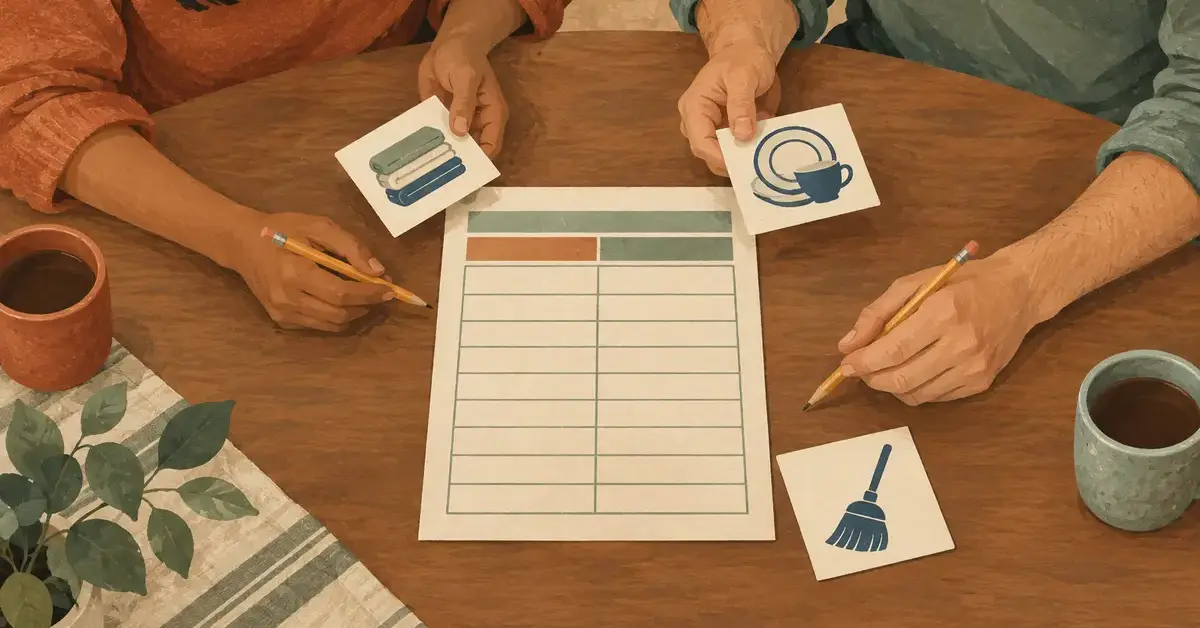
Give the reset a 30-minute limit, and agree to stop when it ends. Spend the first 10 minutes getting your home ready for Monday, then sit down for 20 minutes of planning and conversation. If Sunday isn’t a shared day off, choose another time before your workweek begins.
The aim is to catch the “Wait, you need the car today?” surprises while there’s still time to make a different plan.
Your Sunday Reset at a Glance
| Part | Time | What to settle |
|---|---|---|
| Reset the home | 10 minutes | Clear the spots that would make Monday harder. |
| Compare calendars | 8 minutes | Flag busy days, shared commitments, rides, and changes. |
| Plan food and errands | 5 minutes | Choose a few dinners, make the shopping list, and assign one errand. |
| Check household admin | 2 minutes | Identify deadlines and who will handle them. |
| Check in with each other | 5 minutes | Ask what would help and choose something to enjoy together. |
These are suggested limits, not five separate timers to manage. If there’s no paperwork this week, skip that part. If you already know the meal plan, spend those minutes talking instead.
Before Your First Reset
Invite your partner into a trial run rather than announcing a new household policy. Be specific about the problem you want to solve and the time you’re asking for.
Sample invitation: “Could we try half an hour on Sunday to sort out the week? I’d like us both to know the plan instead of figuring out dinner and rides at the last minute.”
Bring your calendars and choose one place for shared decisions: a notebook, a notes app you can both access, or a board near the kitchen. Use whatever you’ll actually check on Wednesday. Building a new organizational system can wait.
Agree on the scope, too. The reset covers things that affect your shared week. It doesn’t require either person to account for every hour, and it isn’t a standing review of everything that went wrong last week.
Pick a time with a little breathing room. Right before someone leaves for work is a poor slot for discovering that Thursday needs rearranging. If an uninterrupted half hour is rare, do the home tasks earlier and save a shorter stretch for planning together.
Reset the Home Without Starting a Cleaning Project
Choose two or three spots that would make the next morning easier. One week that might mean the sink, the entryway, and tomorrow’s lunches. Another week, finding clean work clothes matters more than clearing the table.
- Kitchen: Make room to prepare breakfast, wash the containers you’ll need, or load the dishwasher.
- Entryway: Put keys and bags where their owners can find them. Move anything blocking the door.
- Clothes: Locate what you need for the next day rather than tackling every basket.
- Tomorrow’s essentials: Check chargers, work gear, lunch bags, or anything that needs to leave with you.
Say which jobs you’re taking before you begin. “I’ll clear the kitchen; could you get the bags and recycling?” is clearer than both of you drifting around, each assuming the other has noticed the same things.
Choose a division that fits your energy and ability that day. Working together can mean doing different amounts or different kinds of work. The agreement matters more than matching each other minute for minute.
Stop at the limit you set, even if the room still looks lived in. The hall closet can consume an entire Sunday and still request a second appointment. Put larger projects on a separate list with a date to discuss them.
Compare Calendars for the Week You Actually Have
Go day by day and have each person mention commitments that affect shared time, responsibilities, or resources. Include travel time and preparation when they change the plan. An appointment at 6 may mean leaving at 5 and eating separately.
You can keep work details private while still sharing what the household needs to know: “I’ll be unavailable until 7” may be enough.
Use these prompts where they apply:
- When will either of us leave earlier or arrive home later than usual?
- Are we sharing a car, arranging a ride, or handling a pickup?
- Will either of us miss dinner or need some time alone afterward?
- Does a delivery, repair visit, or shared appointment require someone to be home?
- Is anything still tentative that the other person might be treating as confirmed?
Name the busiest day and make one useful adjustment
“Thursday looks rough” gives your partner information. “Could you handle dinner Thursday?” gives them a request they can answer. If they’re stretched that day too, simplify the plan rather than assigning them the overflow.
For example, you might choose leftovers, move an optional errand, or prepare a bag the night before. Make the change while you’re looking at the calendar, rather than leaving it at “We’ll figure something out.”
Separate shared invitations from individual plans
Bring up invitations that involve both of you before replying for both of you. Decide who will send the answer. Individual plans need coordination when they affect something shared; they don’t automatically need joint approval.
Sample wording: “Dana invited us for Friday. I haven’t answered for us. Would you like to go?” Or: “I’m seeing Lee on Saturday afternoon. Does that overlap with anything we’d already planned?”
If there’s an open evening, consider leaving it open. It can stay available for resting, separate interests, or deciding together that night. Unscheduled time doesn’t have to become another assignment.
Plan Enough Food and Errands to Get Started
A useful meal plan can be rough. Start with the next few days and the evenings that need a definite answer. Check what’s already in the fridge or freezer before choosing meals that require another shopping trip.
Match effort to the calendar. The late-shift night gets something easy. An evening you’re both home might suit cooking together, if you enjoy it. Eating separately can also be the sensible plan.
Example weekday sketch:
- Monday: Pasta with vegetables already on hand. One person cooks; the other handles dishes.
- Tuesday: Leftovers. Each person reheats dinner when they get home.
- Wednesday: A freezer meal for a late evening. Check now that there’s enough.
- Thursday: Decide together that morning, with a pantry option as backup.
Add missing ingredients to the shared list immediately. Then settle who shops and when. Cooking, checking supplies, shopping, and cleaning up are separate jobs; saying “I’ll make dinner” doesn’t automatically settle the other three.
Keep food choices within whatever spending limit you’ve already agreed on. Takeout can be an option, but the routine should also work without buying dinner or special organizing supplies.
Give one lingering errand a clear finish
Choose the return, library trip, or repair pickup that keeps moving from week to week. Name the person handling it, the day, and anything needed to complete it.
Sample agreement: “I’ll take the return Tuesday after work. Could you put the receipt in the bag tonight?”
If the timing doesn’t work, change it now. A realistic Thursday plan is more useful than an optimistic Monday promise neither of you expects to happen.
Scan Household Admin for Deadlines
Use this part to identify actions, not to work through an entire inbox. Check the next seven days for:
- Payments or renewals that need attention
- Forms, signatures, and return deadlines
- Appointments to arrange or confirm
- Cards, gifts, or replies you’ve agreed to send
- Household calls that still need making
Record who will do each relevant task and by when. Access matters: someone agreeing to make a call may need an account number, permission from the account holder, or information only the other person has. Sort out that handoff rather than discovering it during the workday.
Larger decisions deserve a separate slot. If a major purchase or an involved household problem comes up, write down the question and choose a time to discuss it. The two-minute scan ends once you know the next action; it doesn’t require finishing the paperwork before you can move on.
Put the List Down and Check In
Close the calendar and stop adding chores for a few minutes. Ask each other one or two questions, taking turns answering:
- What are you looking forward to this week?
- Is there something coming up that you’d like help with?
- Would you like more company, more space, or a different kind of support this week?
Either person can pass. “Nothing comes to mind” is also a complete answer. The check-in shouldn’t require a meaningful revelation every Sunday.
Listen before offering solutions. If your partner mentions a difficult presentation, you might ask, “Would it help to practice it with me, or would you rather have a break from thinking about it?” A specific offer leaves room for a useful yes or no.
Then choose one thing you’d enjoy together. Fit it to the week you’ve just planned: a walk, a board game, an episode of a show, breakfast at home with no errands immediately afterward. It can be familiar and free.
If a bigger concern comes up, acknowledge it rather than forcing it into the remaining minute. Sample wording: “I want to hear the rest of that. Can we set aside time after dinner tomorrow?” Agree on a time you can both keep.
One person may enjoy calendars more. That preference doesn’t mean they need to become the household’s search engine.
Each person should bring their own relevant dates, check their own commitments, and review the shared decisions. You can rotate who leads the conversation, or keep consistent roles if both of you prefer them. Either way, both need access to the result.
For recurring jobs, agree on what taking responsibility includes. Handling a return might mean checking the deadline, finding the receipt, taking the package, and confirming it’s done. If one person still has to notice every step and issue reminders, the handoff is incomplete.
Acknowledge uneven workloads directly. Some weeks one person can take on more; over time, both should be able to say when the arrangement needs changing.
Sample wording: “I’ve been tracking the groceries and the appointments. Could you take responsibility for appointments this month, including the reminders?”
Before closing the list, read back the decisions that involve both of you. Writing something down records an agreement; it doesn’t create one without the other person’s answer.
Adapt the Routine to Your Household
For opposite shifts
Add your relevant dates to a shared note before your brief overlap. Use the conversation for conflicts and decisions rather than reading every entry aloud. Home tasks can happen separately. If you can’t talk live, leave clear proposals and confirm them; an unanswered message is still pending.
With children at home
Invite children to handle age-appropriate preparation, such as putting a backpack by the door or returning toys to a bin. Include them for their schedule details when useful, then keep the couple check-in separate. Splitting the routine into daytime preparation and an evening conversation may fit better than seeking an uninterrupted half hour.
When you’ve recently moved in together
Use concrete requests instead of assuming you share the same definition of “ready for Monday.” One person may mean clean counters; the other means knowing where the work uniform is. Choose a few shared priorities and revise them after you’ve tried the routine.
During a tiring or disrupted week
Reduce the task list before asking either person to work faster. Handle the deadlines, tomorrow’s essentials, and any schedule conflict. Leave the rest visible for later, with a clear distinction between postponed and promised.
The 10-Minute Version for a Crowded Sunday
Skip the full routine when it doesn’t fit. Use this shorter version instead:
- Two minutes: Each person names the biggest schedule change or busiest day.
- Three minutes: Settle tomorrow’s food, transport, and anything that must leave the house.
- Three minutes: Assign urgent tasks and prepare one troublesome spot, such as the sink or entryway.
- Two minutes: Ask what would help this week and choose a time to catch up.
Anything unresolved goes on the shared list with a time to revisit it. If tomorrow’s plan is settled and there are no urgent conflicts, stop there. You can return to the longer version another week.
Copy this compact checklist so either person can lead. Cross out what doesn’t apply rather than treating every line as compulsory.
- Choose today’s time limit.
- Clear the spots that matter for tomorrow.
- Share dates that affect each other.
- Confirm rides, pickups, and shared resources.
- Make a specific plan for the busiest day.
- Answer pending invitations that involve both of us.
- Choose the next few dinners and who handles them.
- Check supplies and assign the shopping.
- Give one lingering errand a person and a day.
- Check deadlines and arrange any handoffs.
- Read back shared decisions and confirm agreement.
- Ask what would help; passing is welcome.
- Choose something to enjoy together.
- Set a time for any conversation that needs longer.
Change the Parts That Aren’t Helping
If the reset keeps running long, notice what’s consuming the time. Choosing five recipes might need its own session. Reading every calendar entry may be unnecessary when only three affect your partner. Drop the repetition and keep the decisions.
If one person regularly arrives unprepared, agree on what each of you will bring next time. If Sunday has become crowded, move the routine rather than repeatedly squeezing it into an unsuitable slot.
After a missed week, start with the week in front of you. There’s no backlog of Sunday resets to complete.
Once you’ve confirmed the plan, close the note. Leave the closet project, the optional errand, and next month’s calendar alone for now. The rest of Sunday is still yours.