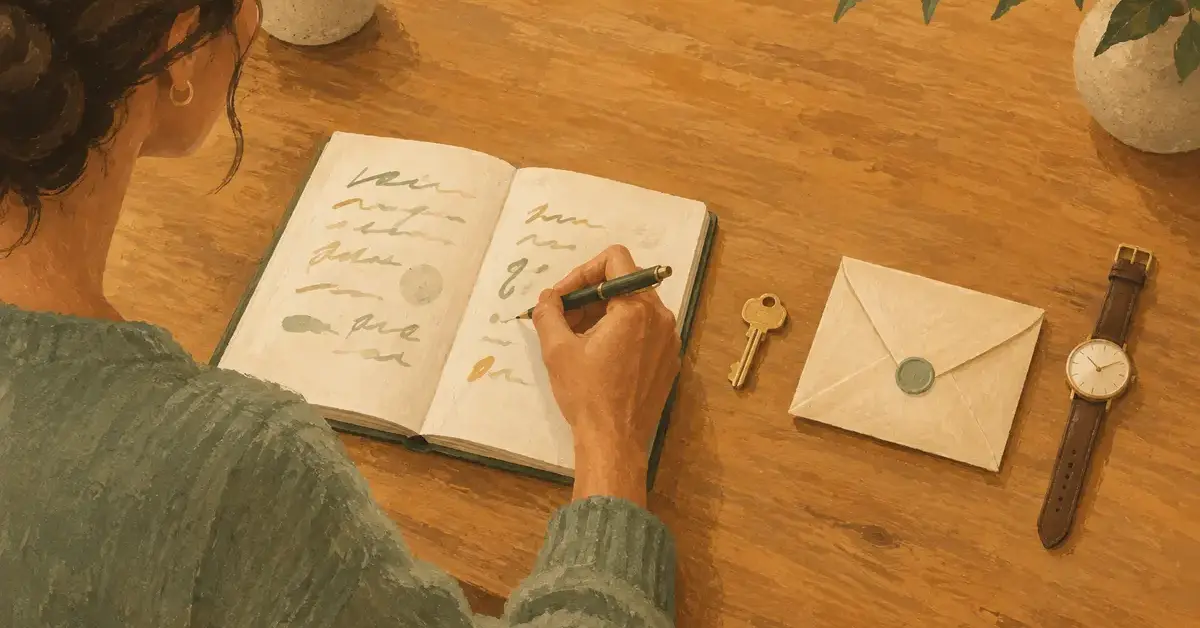
Choose one prompt, write a few lines, and use details from the week you’re living. Keep necessary responsibilities in view; look for the places where you actually have a choice. Skip anything you’d rather leave off the page, and keep your answers private unless you choose to share them.
Start With the Week You Actually Have
-
Write down what you did yesterday, from waking up to falling asleep. Label each activity: “wanted to,” “needed to,” or “assumed I should.”
Some activities deserve two labels. You might enjoy cooking dinner and need to feed yourself. Leave room for uncertainty, too. The aim is to distinguish a real responsibility from a rule nobody actually asked you to follow.
-
Which part of a normal weekday do you protect, and which part do you give away first when things get busy?
Use your most recent busy day rather than your ideal schedule. Perhaps your walk disappears, but an optional meeting stays. Write down what happened and whether you agree with that trade. Practical constraints belong in the answer alongside preferences.
-
List three things you did this week because “that’s what you do.” Where did you learn each one?
A parent, a former boss, a roommate, a television family: name a source only if you remember one. “I’m not sure” is a useful answer. Then mark which habits still serve a purpose you care about.
-
When did you last have an unscheduled hour? Write what you did with it and what you felt you should have done instead.
Keep both accounts plain: “I watched a movie” and “I thought I should organize the closet.” Decide whether the second activity had an actual deadline or was merely waiting to claim any available time.
-
Describe a task you always do the long way. What does the extra effort give you?
Maybe you write a full email when two lines would do, or prepare every part of a meal from scratch. The longer version might be satisfying. It might also be a standard you follow without liking the result any better. Compare the two versions on their merits.
-
Rearrange one ordinary Tuesday around your preferences, changing only the parts where you have real say.
Keep work, caregiving, appointments, and other commitments intact. Skip the fantasy Tuesday at a lake house. Move an errand, change the order of your evening, or leave a free hour unclaimed. Separate changes you can make yourself from those that would require a conversation.
Separate Your Preferences From Borrowed Rules
-
Finish this sentence several times: “A good adult always…” Then decide which endings you agree with.
Include the ordinary rules: keeps a spotless home, replies immediately, has weekend plans, sends thank-you notes. Beside each, write “I agree,” “depends,” or “I don’t agree.” A familiar rule can stay; familiarity alone doesn’t have to settle the question.
-
Whose opinion do you imagine when you’re deciding how to spend a free evening?
Write down the choice you want to make and the reaction you’re anticipating. Separate anything that person has actually said from what you’re assuming. You may discover that you’re choosing around a real disagreement—or an audience that hasn’t been consulted at all.
-
What did the home you grew up in treat as nonnegotiable? Which of those rules still run your home?
Dinner at six, shoes off at the door, no dishes left overnight, visitors welcomed without notice. Choose one rule and consider how well it fits your current household. Include the preferences of anyone sharing the space rather than replacing one person’s default with another’s.
-
Think of a recent choice someone close to you didn’t understand. Describe it from your side without defending it.
Write what you wanted and what made the choice workable for you. Imagine explaining it to someone who already likes you and wants the full picture. Leave out the rebuttal to an argument you aren’t having on this page.
-
Name an expectation you picked up at work that followed you home.
Answering every message within minutes. Turning a casual outing into an itinerary. Apologizing before asking for something. Identify where the habit helps and where it adds work. A useful workplace practice can have a narrower job in the rest of your life.
-
Define “enough” for an ordinary day with your current responsibilities. What do you keep adding after you’ve reached it?
Count paid work, caregiving, household tasks, and other demands on your time. Distinguish what must happen today from an optional finishing touch. This is a description of your present circumstances, not a standard you must meet every day from now on.
Your Home, Your Belongings, Your Spending
-
Walk through one room and list three objects you keep mainly because you feel you should.
The unused gift, the matching set, the decorative bowl that has never found a spot. For belongings that are yours to decide about, note “keep,” “use elsewhere,” or “pass along.” Put shared items on a discussion list. Nothing needs to leave the house today.
-
Write your definition of “a nice home.” Compare it with the version you grew up with or see online.
Describe what the rooms let you do, as well as how they look. Perhaps the dining table is for jigsaw puzzles, or clear surfaces matter more to you than coordinated furniture. Note one feature you already have that fits your definition.
-
Name one optional expense you’d happily keep and one you wouldn’t miss.
Use actual purchases or subscriptions rather than an imagined shopping list. Write what you get from each: enjoyment, convenience, participation, habit, or something else. Keep essential bills separate from this exercise. You’re examining preferences, not judging every dollar you spend.
-
What chore do you do on someone else’s schedule?
Perhaps Saturday mornings became cleaning time because that was the rule growing up, though another time suits your week better. Sketch an alternative using your actual schedule. If someone shares the task, note what you’d need to ask before trying the change together.
-
Describe a recent purchase, borrowed item, or free find that pleased you more than you expected.
A pen that writes well, a library book you kept reaching for, a chair moved to a better spot. Be precise about the pleasure: ease, color, comfort, usefulness, novelty. That detail may say more about your taste than the item’s category or price.
-
Which “grown-up” purchase or upgrade keeps landing on your list even though you suspect you don’t want it?
The formal dining set, the matching luggage, the kitchen appliance everyone recommends. Write what you expect it to change about your daily life. Then name what you’d prefer instead, including keeping what you have or buying nothing.
People, Plans, and Obligations
-
Choose three recent social plans. Compare how you felt before each one with how you felt afterward.
A plan you resisted may have been lovely once you arrived; an anticipated event may have left you wishing for an earlier exit. Note whether the company, activity, timing, or travel made the difference. Avoid giving the whole friendship a verdict based on one evening.
-
Who do you see out of habit, and who do you wish you saw more?
Sometimes those are different people. Sometimes it’s the same person in a different setting: your sister at a crowded holiday table versus your sister on a walk. Describe the kind of time you’d enjoy together, not only how often you meet.
-
What role do you usually play with friends or family? Which parts would you keep, share, or rotate?
Planner, host, birthday-reminder person, the one who always brings the extra chairs. Separate the parts you enjoy from the parts you do by default. If you want a change, name a specific task someone else could choose to take on.
-
Write about a tradition that no longer fits your current life. Keep one meaningful part and describe one change you could propose.
You might want the family meal without preparing every dish, or the annual gathering at a different time of day. Be clear about what matters to you: the people, the food, the place, or the ritual. Other participants may value a different part.
-
Draft a short, kind way to decline something you usually agree to.
A sample to adapt: “Thank you for thinking of me. I’m going to sit this one out.” If you want another kind of time together, add a specific invitation. Leave that offer out when you don’t mean it; a polite decline can stand on its own.
-
Think of someone around whom your preferences come easily. What do you say or do with them that you hold back elsewhere?
Maybe you suggest the restaurant you actually want, admit you haven’t seen the popular show, or ask to head home earlier. Pick one ordinary preference you’d like to state more plainly in another setting where it’s welcome.
Your Own Taste, in Plain Sight
-
List twenty things you like, with no category too minor.
Cold pillows, the Monday crossword, the first page of a library book, arriving early, a certain shade of green. Include things you enjoy without a reason you can explain. When you finish, circle the ones that already have a place in your week.
-
What harmless preference do you downplay because it seems unfashionable, ordinary, or unlike the person others expect?
Daytime movies, dinner at four-thirty, rereading the same mystery series. Write what you enjoy about it without presenting a case for its cultural value. Keep the answer private if you prefer; liking something doesn’t require making it an announcement.
-
Which activity do you enjoy without needing to be good at it?
Describe what you like about the doing, apart from improving, sharing the result, or being useful. Singing while you cook, sketching crooked buildings, and playing a familiar game all count. Note whether judging the result has been getting in the way of the part you enjoy.
-
Which recent activity ended with you thinking, “I’d like another half hour”?
Use a specific occasion: a conversation, a project, an afternoon outside. Write what held your interest and what brought it to an end. Consider whether that activity already gets a fair share of your available time, without turning every pleasure into another scheduled obligation.
More of This, Less of That
-
Make two columns, “More” and “Less,” and put five items from your current week in each.
Use actions and situations you can recognize. “More reading” can become “read before opening social media.” “Less rushing” might mean “stop fitting an errand between work and dinner.” Include things you control, and mark anything that depends on someone else’s participation.
-
Choose one item from either column and design a low-stakes test for this week.
Write exactly what you’ll do, when you’ll try it, and what would tell you it fits. You could leave one evening unplanned or ask another willing person to choose the next group outing. Keep existing commitments in view and make the test easy to adjust.
-
Write a note about one expectation you’re keeping on purpose.
Some inherited habits still suit you: calling a relative on Sundays, sending thank-you notes, arriving on time, making a particular holiday dish. Say what you value about this one now. Its origin doesn’t disqualify it from being yours; your present agreement matters, too.
Use Your Answers Without Turning Them Into Another Assignment
Choose a pace that fits
For a quick start, try prompts 1, 8, and 29: what filled your day, whose opinion you anticipated, and what you want more or less of. For a slower approach, answer one prompt at a time or choose a section that interests you. A few sentences can be a complete entry. Returning after a gap requires no catching up.
If you use the list with a friend, write separately first and share only the answers you both want to discuss. Either person can pass on a prompt or decline a follow-up question. Listen before offering suggestions; your friend may be describing a preference rather than asking you to solve something.
Read for distinctions, not verdicts
After a few entries, underline statements of preference and circle statements of obligation. Check what makes each obligation necessary: a deadline, a promise, a shared responsibility, or an assumption. Keep “I don’t know yet” available. One tired evening is limited evidence for deciding what you want from every evening.
You can also mark an answer “borrowed and useful,” “ready to reconsider,” or “not mine to decide alone.” These labels leave room for a family custom you love and a shared arrangement that needs discussion. The source of a habit is one part of the answer, not the whole decision.
Try one change, then check the result
Keep your more-and-less page nearby and put a date beside the test you chose in prompt 30. When you return to it, record what actually happened before deciding to keep, adjust, or drop it. Perhaps an earlier errand helped. Perhaps leaving the evening open felt less appealing than expected. Either result gives you something concrete to work with.
For a change that affects someone else, bring the specific proposal into the conversation. A sample to adapt: “I’d prefer to do the big grocery trip on a weeknight instead of Saturday. Would that work with your schedule?” Their answer belongs in the plan alongside yours. Keep the notebook as a place to sort your preferences, not as a set of instructions everyone around you must follow.