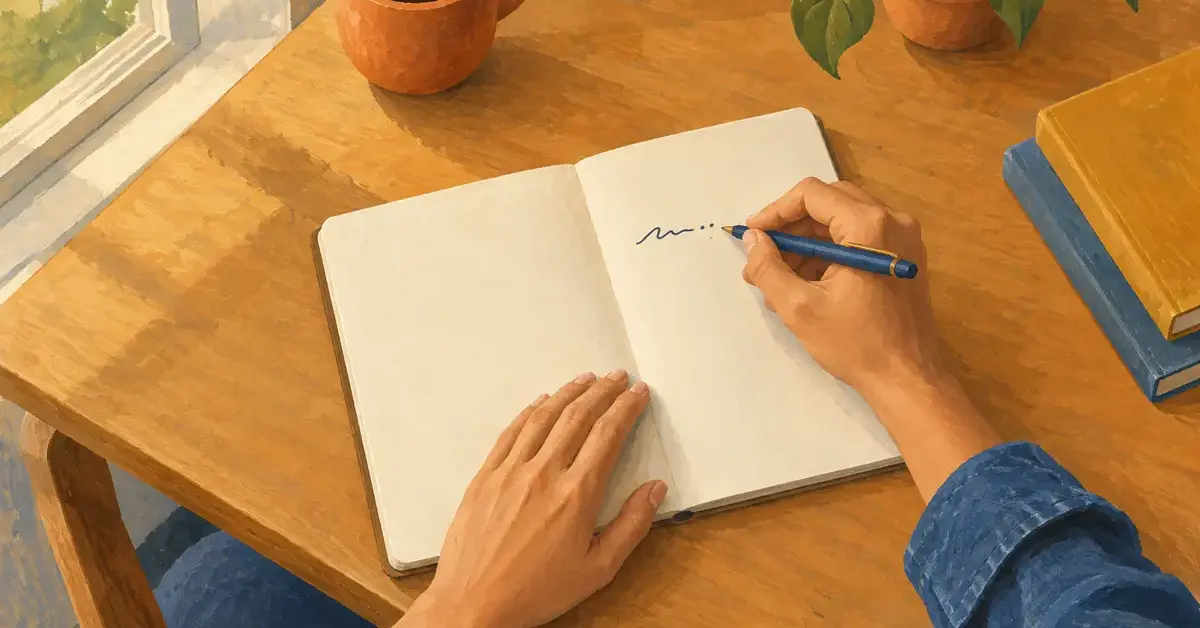
Turn to the next clean page, write today’s date, and put down one thing you’d like to remember. It can be as ordinary as what you did when you got home. Here’s a complete first entry:
November 6. The book I’d been waiting for came in at the library. I read the first chapter with my coat still on.
That’s enough for a return. The notebook doesn’t need an apology, and today’s entry doesn’t need a summary of everything that happened since the last one.
Find Your Place Without Filling In the Gap
- In an undated notebook: If there’s room under your last entry, draw a line and write the new date below it. If you’d rather have a whole page, turn to one. Both work, even if the last date you wrote was years ago.
- In a dated journal: Flip past the missed days. If the whole planner is out of date and you still like using it, cross out the printed date on an unused page and write today’s. Or move to an undated notebook so the next page is always yours to use.
- In a notes app or document: Start a fresh note or add a heading with today’s date at the end of your file. The unfinished entry above it can stay unfinished.
If you keep rereading instead of writing, mark the old entry and come back to it later. There’s pleasure in finding out what mattered to you on an ordinary Thursday three years ago. It can have an evening of its own.
First Lines for the Day You Come Back
Borrow the line you can finish without thinking too hard. If one sentence says what you came to say, stop there.
- I picked up this notebook today because…
- One thing that’s different since I last wrote is…
- From where I’m sitting, I can see…
- Something someone said today that I want to get down while I still remember it was…
- Lately, I’ve been spending my spare time on…
- The next thing I’m looking forward to is…
- Today in three lines: This morning… By lunchtime… Tonight…
On a day when even a prompt feels like a lot, record the plain fact: I found this notebook in the bottom drawer. I thought I’d write in it again.
When There’s Something From the Gap You Want to Keep
After a move or a change in your routine, a sentence about what’s different can bring the journal up to date without asking you to tell the whole story. A first line might read: Last time I wrote, I was still taking the train downtown. Now I work at the kitchen table, and I know exactly when the neighbor’s dog goes out.
If there’s a particular memory you wish you’d written down, put it under today’s date with a cue like From July or One thing I remember about moving. Keep the part you actually want to read again. For example: From July: On our last night in the old apartment, we ate sandwiches on the floor. The chairs were already in the truck.
Keep What You Liked, Change What Made You Stop
If writing took too long, make the entry shorter before you try to find a bigger stretch of time. If you used to recap the whole day, pick one scene: the first walk through your new neighborhood, the moment dinner finally made it onto the table, the last five minutes of a visit. Start inside that moment and leave the rest of the day out.
If the entries had started to sound alike, change what you notice. A journal that turned into a running list of errands can hold what happened while you were out instead. Went to the hardware store is a record. The store still has the same bell over the door is a detail you might like coming across later. Either belongs; pick the kind of entry you want to write.
If the old notebook feels finished, even with pages left, set it aside. A notebook you kept through school, a particular job, or a stretch of travel can belong to that time. Start a fresh one or open a new note with a plain label like November onward. There’s no closing entry to write first.
Make the Next Entry Easy to Start
Set the notebook where you’re likely to use it, with a pen tucked inside. If you like to write on the couch but prefer to keep the journal private, the side-table drawer is a better home than the top of the table. If you usually think of things to write when you’re out, keep a note on your phone and let it be an entry in its own right. Copying it into the book is optional.
Use a moment that still exists in your day. The bedtime routine that worked before your schedule changed might be gone, but you may have a few minutes after lunch or a stretch of Sunday morning you like to keep for yourself. Once a week is a workable rhythm if that’s when you feel like writing.
When a planned writing day goes by, leave it blank. If you miss Tuesday, Wednesday can have its own entry.