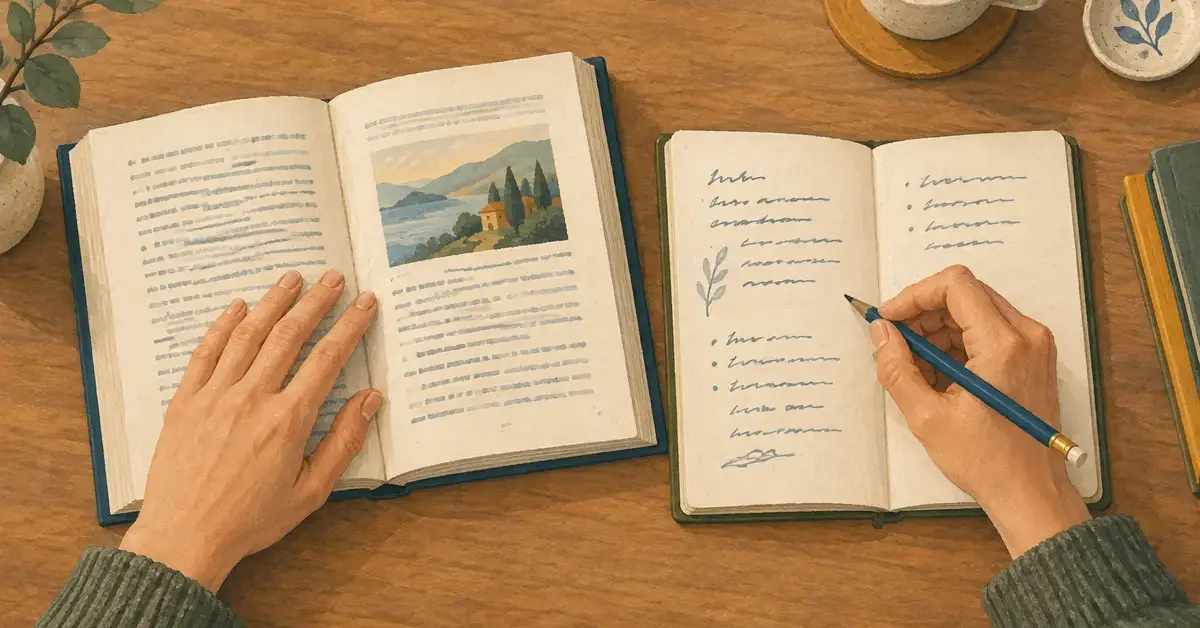
A commonplace book collects selected material from your reading alongside your own observations. You might copy a sentence, summarize an argument, or connect two authors who seem to be talking about the same thing. The source stays attached, and your response explains why you kept it.
A reading log records which books you finished. A commonplace book follows what caught your attention—even if you found it in a book you never finished.
Make One Entry Before You Organize Anything
Open a notebook or a blank digital note beside whatever you’re reading. Choose one passage that still interests you after a second look, then record these four things:
- Topic: Give the entry a short heading you could search for later, such as friendship, public spaces, or writing dialogue.
- Source: Write the author, title, and page or other location. Add publication details where they help identify the work.
- Passage or idea: Copy the wording exactly and label it as a quotation, or summarize the point in your own words and label it as a paraphrase.
- My response: Add what you noticed, questioned, connected, or might use. One specific sentence is enough to begin.
Put the date beside the entry if you’d like to follow how your thinking changes. Then stop. A useful first entry does more for this project than an elaborate system with nothing in it.
See How the Pieces Work Together
The following examples are invented for illustration. The sample passage and ideas are original. The source lines list fields to fill in; they are not references to actual publications.
A Sentence From a Novel
Topic: Welcome; character through action
Source fields: Author, novel title, edition, chapter number, page number
Quotation: “She brought out another chair before asking who was coming.”
My response: The order of the actions suggests welcome: she makes room before she knows whom it’s for. But it could also be habit. Watch what she does when the guest arrives.
This entry keeps the wording because the wording is what interests the reader. The response points to a particular choice in the sentence and leaves a question to follow through the novel.
An Idea From a Practical Article
Topic: Organizing by task
Source fields: Writer, article title, publication, date, web address or page
Paraphrase: Keep frequently used supplies close to where you use them, even if that means separating things that belong to the same category.
My response: I usually group supplies by type. This suggests grouping by task instead. Sketch a possible arrangement for the entryway shelf before moving anything.
Here, the exact phrasing isn’t the attraction. The entry captures an idea and gives it a possible application. A commonplace book can accommodate both kinds of attention without making every note look alike.
Choose a Home for the Collection
Use something you can reach while reading and return to without much setup. An ordinary notebook, a notes app, a document, or a box of cards can all hold these entries.
For Paper
A bound notebook keeps everything together. Leave a few pages at the front for an index, then start writing. Number pages as you use them rather than turning the first evening into a numbering project.
If rearranging matters to you, consider a binder or index cards. Keep each entry together, including its source. A quotation on one card and its attribution on another creates an avoidable mystery.
For Digital Notes
Choose either one note per entry or a single document with clear headings. Use the same field labels each time so the source and your response don’t disappear into a block of copied text.
Search is helpful, but it depends on words you actually recorded. A heading such as “belonging” will be easier to retrieve than “interesting passage.” Include the author’s name and title as text, even when you also save a link.
If you’re undecided, use what you already have. Try a handful of entries before buying supplies or moving your reading into a new app. You’ll have a better sense of what feels inconvenient after using a system than after comparing its features.
Choose What Deserves an Entry
Highlighting can happen in a second. Deciding to keep something asks a little more of you. Before copying a passage, name what drew you to it.
- The wording does something you admire. Perhaps a description creates tension without naming it, or a line of dialogue reveals more than the character intends.
- The idea changes a distinction. An author separates two things you’ve been treating as identical, and you want to work out the difference.
- You disagree. Record the argument fairly, then identify the assumption or example you question.
- Something needs checking. Save the claim with its source and mark the unresolved question. Recording a claim isn’t the same as confirming it.
- Two readings connect. A passage reminds you of another book, perhaps because the authors reach similar conclusions for different reasons.
- You can see a use for it. An idea might help you plan a gathering, explain a problem, or start a book-club conversation.
Not every enjoyable sentence needs to come home with you. Some belong to the pleasure of that particular chapter. If you can’t say why you’d want to return to a passage, leave the flag in place and decide later.
Finishing a book also creates no obligation to make an entry. The collection can have gaps. Its purpose is selection, not proof that you read attentively.
Record Enough Source Detail to Return
A source note should help you find the material again and distinguish it from something you wrote yourself. It can be compact; it needs to be usable.
- Print book: Author, title, page number, and edition or publication details when needed to identify your copy. A chapter heading can provide another useful landmark.
- Ebook: Author, title, chapter or section, and the location or page reference available in your edition. A few identifying words from the passage can help you search within the book later.
- Online article: Writer, headline, publication or website, publication date if shown, and the link. Record an update date too if it’s relevant to the idea you’re saving.
- Print article: Writer, headline, publication, issue or date, and page.
- Audiobook or other listening: Author or speaker, title, chapter or episode, and timestamp. Label a note from memory as a remembered idea rather than an exact quotation.
If you collect several passages from one book, you can write its full details once and use a short title for later entries. Keep the reference clear enough that it won’t become ambiguous when a second volume or similarly titled book enters the collection.
When you encounter a quotation inside another work, record what you actually consulted. Write “Quoted in,” followed by the book title and page, rather than implying you read the original. If you later check that original, add the new reference.
Keep Borrowed Words Separate From Your Own
Use quotation marks or a clearly labeled quotation field for exact wording. Put your response beneath a separate label. That visual boundary matters when you return months later and can no longer remember which sentence came from whom.
Copy carefully. If you shorten a passage, make the omission visible and check that the remaining words still represent the point. Keep enough surrounding context to understand who is speaking and what the sentence refers to.
For a paraphrase, read the relevant passage, look away, and explain the idea in language you would use. Then compare your version with the original for accuracy. Swapping a few words while retaining the author’s phrasing won’t give you a clearly independent summary.
Attach the source to a paraphrase too. The wording may be yours, but you still want to know where the idea came from. If you’re uncertain about a detail, label the uncertainty instead of letting the notebook make it look settled.
Make Your Response Specific
Your response is where the collection becomes personal without becoming a diary. It can concern your life, but it starts with something in the reading: a claim, a technique, a question, or a connection.
“Beautiful” records approval. “The description stays with sound until the final sentence, when we finally see the room” records something you can study. “Interesting idea” gives you little to return to. “This recommendation assumes the whole group has the same schedule” gives you a point to consider.
When you stall, choose a prompt that suits the passage:
- The distinction I want to remember is…
- The example that convinces me—or doesn’t—is…
- This seems to assume…
- I would explain the idea to a friend this way…
- This connects to my note on…
- A situation where I might use this is…
- Before accepting this claim, I want to check…
Follow the thought as far as it remains useful. Some responses need a line; an argument you’re trying to untangle may need a page. Length isn’t a measure of attention.
When connecting two sources, name the connection. “Reminds me of that gardening book” is a starting point. “Both authors recommend observing before making changes, although one is discussing a garden and the other a meeting” gives you something to develop. Record both sources so the comparison can be checked.
Keep Reading and Recording Separate When It Helps
Stopping at every good sentence can make a novel feel like a transcription assignment. Try marking possibilities while you read and choosing entries afterward.
In your own books, use whatever marking method you prefer. For borrowed books, use a separate page-number list or bookmarks rather than writing in them. Digital highlights can serve as a temporary holding place too.
At the next convenient pause, reread the marked passages. Choose the ones that still interest you, record their sources, and add your responses. The second look may change your selection. A striking sentence can lose its appeal outside the paragraph; an understated observation can become more interesting.
If you prefer making an entry while the book is open, do that. The useful distinction is between noticing everything and saving everything. Your commonplace book doesn’t need to reproduce your entire highlighting history.
For listening, a timestamp and a short note can preserve the idea until you can return. Check the recording or an available text before treating remembered wording as an exact quotation.
Organize for Retrieval, Not Display
Start with chronological entries and short topic headings. This lets you keep reading while your actual interests emerge. Dividing a new notebook into fixed sections can leave one topic crowded and another with thirty empty pages.
Build a Modest Index
For paper, add topics and page numbers to the index at the front. One entry can appear under more than one heading. A note about a novel’s dinner scene might belong under both hospitality and dialogue.
Choose consistent terms. If you use “friendship,” keep adding to that heading rather than scattering similar entries under “friends” and “being a friend.” Add an author or title heading when you expect to look for a work directly.
In a digital collection, the equivalent might be tags or a topic list linking to individual notes. Begin with a few useful labels. Add another when you have material that warrants it.
Link Entries Where the Connection Matters
Write “see page 18” beside a related entry, then add a return reference on page 18. In digital notes, use an internal link if your tool supports it, or record the other entry’s title.
If several entries share a page, give them short titles or entry numbers so the reference is precise. Keep one reference method consistent enough that future you can follow it without decoding a color key.
The index tells you where to find something. A cross-reference records why two things belong in conversation. Both can be brief.
Know the Boundary Between Saving and Sharing
Make a separate decision before posting notebook pages or reproducing passages elsewhere. An entry that works for your own reference may contain more borrowed text than you need for a public discussion.
Keep attribution attached to anything you quote or paraphrase. For a planned publication, public post, or distributed handout, check the work’s reuse terms or the rights holder’s permissions process. Don’t treat a credit line, a particular word count, or the fact that you copied it by hand as a permissions check.
You can also share your response without displaying the excerpt: name the book, identify the idea you’re discussing, and explain your question or connection in your own words. Avoid letting photographs of notebook pages reveal private annotations or information about other people.
Build this separation into your notes now. Clear quotation and response fields make it easier to see which parts are your writing when you consider sharing something later.
Fix the Snag You Actually Have
- The notebook feels too special to write in. Use the next page for an ordinary entry from your current reading. Skip the title page and decorative key until you want them. A crossed-out word won’t prevent you from finding an idea.
- You’re copying long passages without responding. Pause before the next transcription and identify the sentence or claim you care about most. Keep that portion, with enough context, and explain the attraction. A longer excerpt should have a reason beyond being easier than choosing.
- The backlog has become another task. Choose a few marked passages that still interest you. Leave the rest in the book or highlight list. Resume with what you’re reading now rather than assigning yourself a catch-up marathon.
- You forgot a source. Try the original reading record, ebook search, or browsing history. Until you recover it, label the entry “source unconfirmed” and keep it out of anything you plan to quote publicly.
- The topics seem unrelated. Keep collecting before forcing a theme. An observation about a bus stop and a sentence about a family dinner can occupy neighboring pages. The index can handle the difference.
- You changed your mind. Date a new response beneath the old one. Explain what changed: another book, a better example, or a closer reading. Keeping both notes preserves the reasoning rather than only the latest verdict.
Return to the Entries and Use Them
Choose a review point that fits your reading: before returning a library book, after finishing a novel, or during an occasional notebook session. Read a few older entries before adding new ones. Update a source, answer a question, or make a cross-reference when something catches your attention.
For book club, choose one passage and one question rather than bringing every note. The source lets you find the passage; your response supplies a conversation beyond a rating.
For your own writing, gather entries on a topic and write a fresh paragraph explaining how they relate. Look for agreement, disagreement, and gaps. Keep source references attached as you move material into a draft.
You can also return to an entry for the pleasure of reading it again. A collection doesn’t need to produce an essay, a project, or a polished opinion to earn its place on your shelf.
For your first sitting, use the book already within reach. Record one source, one selected passage or paraphrase, and one sentence of response. Give the entry a heading you can find again. The next entry can follow it.